
Anson Projected Versus Actual Release
DAC’s Offender Public Information profile calls its estimate “Projected Release Date.” It is planning information based on the sentence and credits then recorded. “Actual Release Date” looks backward after a custody movement has occurred. A sound retrospective check also reads inactive inmate status and the last movement. The separate Probation/Parole/Post Release Status field shows whether legal supervision continued after prison release.
An Anson County Jail record works differently. A pretrial detainee does not receive a sentence-based projected date. Bond, dismissal, a court order, another hold, or later commitment may control the exit. A short county-jail sentence may have a calculated endpoint, but no public Anson-specific calculator or good-time policy was found. Ask the jail for its credited calculation and actual release time.
| Record | Use | Limit |
|---|---|---|
| Projected Release Date | Plans around the current DAC sentence calculation | Can move before release |
| Actual Release Date | Records departure from DAC prison custody | Does not alone prove supervision ended |
| Jail release timestamp | Records the Anson County Jail door-out event | Must be requested because no local release feed is published |
| Court order or judgment | Explains the legal basis for detention, sentence, or release | May not show the physical processing time |
Locate an Anson Release Date
Begin with the last verified custodian. Anson County Jail is operated by the Sheriff and handles local pretrial or short-sentence custody. Anson Correctional Institution is a DAC state prison. The same county name does not make their records interchangeable. Use a booking number for the jail and a seven-digit offender number for DAC when available.
- Identify the facility and controlling agency. Do not assume that an Anson arrest, conviction, prison location, and release county are the same field.
- For a DAC prisoner, search Offender Public Information by offender number or the fullest supported identity.
- Open the profile and compare Projected Release Date, Actual Release Date, Inmate Status, current or prior location, and last movement.
- For an Anson County Jail sentence, call 704-694-9328 and request the credited sentence calculation plus the actual release timestamp.
- Check the court judgment for the legal sentence and jail credit. Ask whether another hold or transfer affects the apparent endpoint.
- After the date passes, require an actual release entry or staff confirmation. Then read the separate supervision status.
The official OPI search is the public starting point for a DAC state-prison calculation.
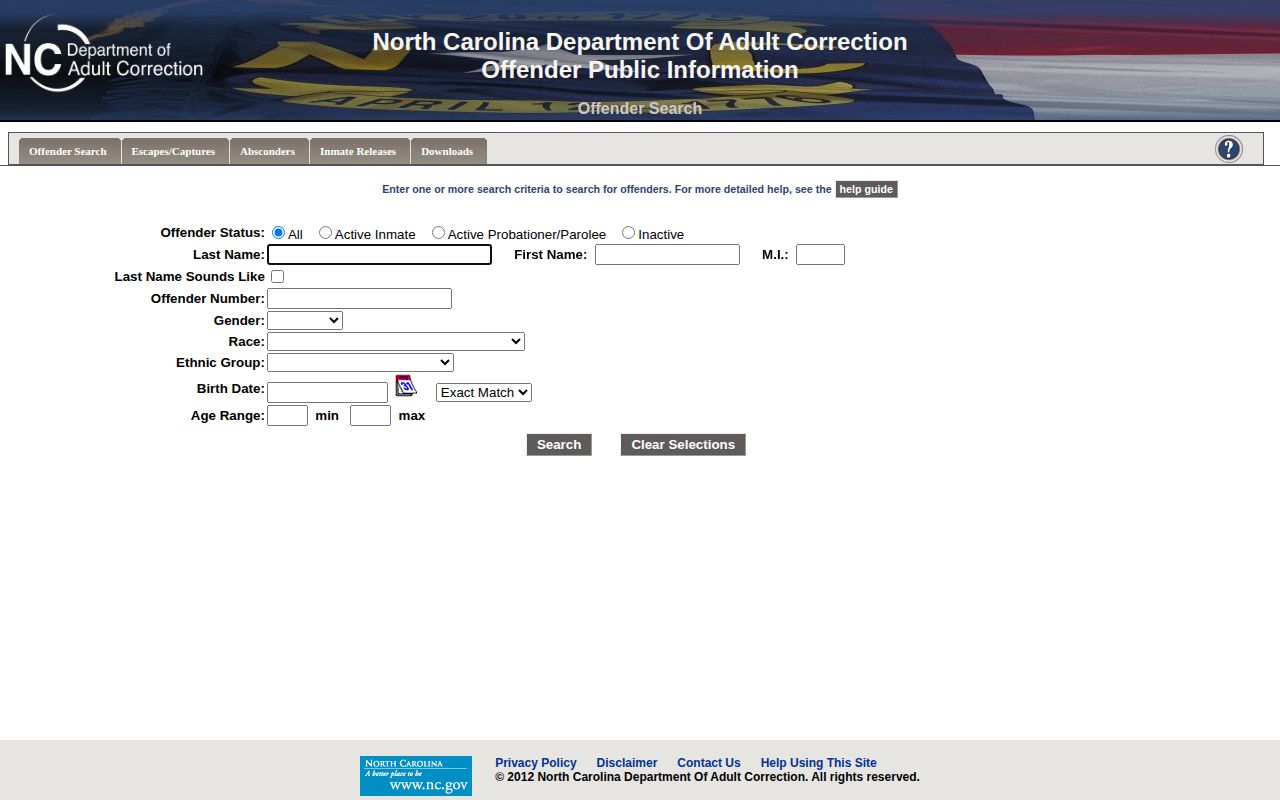
Search controls include active and inactive categories, name and offender-number fields, and identity filters that help separate similar records.
For a named-person inquiry spanning more than one system, the Anson County released inmate search explains the Sheriff, DAC, court, federal, and immigration paths.
Anson Sentences Have No 85% Rule
North Carolina’s modern rule is not a universal requirement to serve 85 percent. Structured Sentencing generally applies to felony offenses committed on or after October 1, 1994. DAC explains that the judgment imposes minimum and maximum terms. The person must serve 100 percent of the judicial minimum. Jail credit counts toward that minimum. Earned time can pull the maximum down toward the minimum, but never below it.
G.S. 15A-1340.13(c) and (d) sets the minimum and maximum framework and the earned-time boundary. G.S. 15A-1355 and G.S. 148-13 authorize credit rules. The maximum-term formulas appear in G.S. 15A-1340.17. For misdemeanors, G.S. 15A-1340.20(d) caps combined earned credit at four days per month. The offense date and class decide which statutes apply.
The official Structured Sentencing statute shows the minimum-term boundary used in an Anson County projected release calculation.
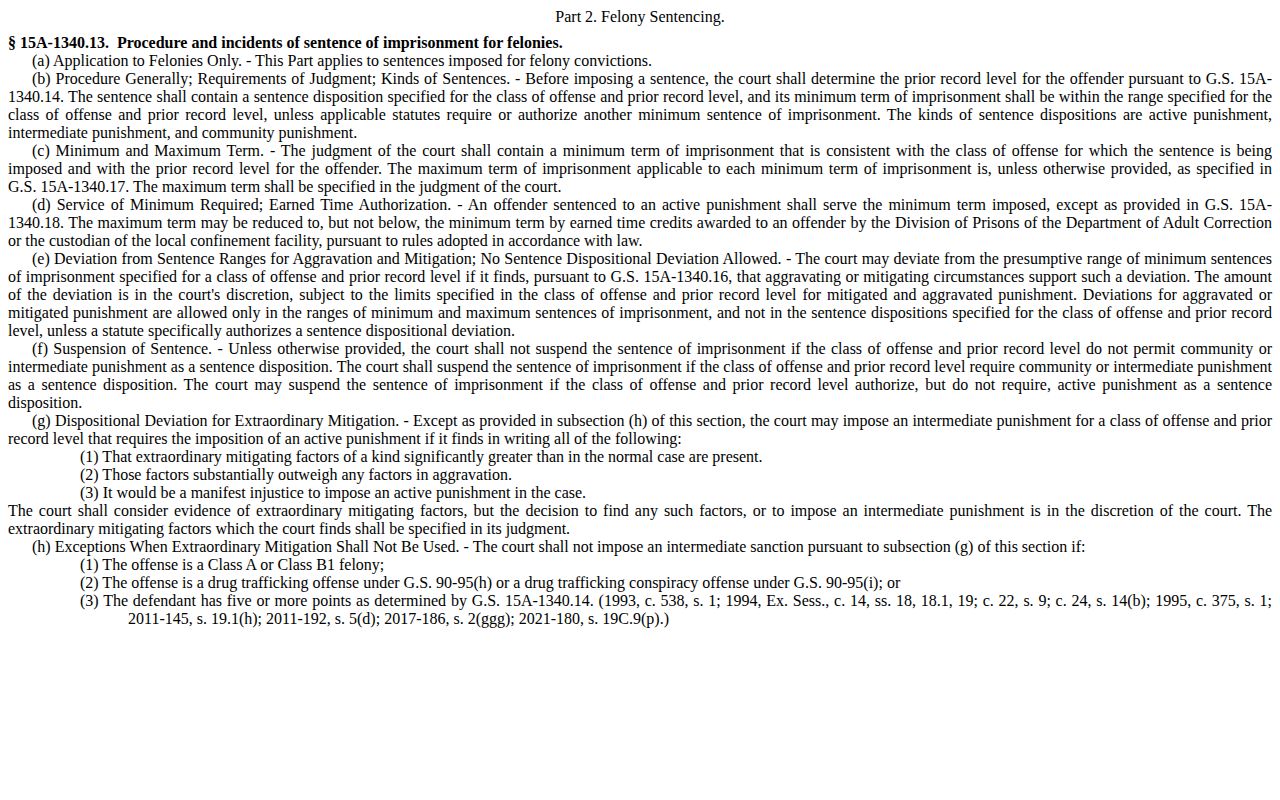
The statute supports a 100-percent-minimum statement, not a shortcut based on a fixed percentage of the full sentence.
Note: A sentence estimate should use the law for the offense date and class, not a rule borrowed from another sentencing era.
Why Anson Release Dates Change
DAC recalculates a projected release date as the source facts change. Some changes result from conduct or program activity. Others come from a court, a newly recognized jail-credit amount, or a movement between placements. The displayed date is therefore a current administrative result rather than an unchangeable promise.
| Factor | Possible effect | Where to verify |
|---|---|---|
| Work or program assignment | Credits may change under applicable DAC rules | Updated OPI date or DAC record |
| Program completion | Eligible credit may be added | DAC calculation |
| Discipline | Earned or program credit may be lost | Updated DAC record |
| Jail credit | Credited time may alter the calculation | Judgment and DAC calculation |
| Vacated conviction or resentencing | The sentence basis can change | Filed court order and DAC update |
| Transfer or new hold | The person may leave one facility without community release | Last movement and receiving agency |
Merit credit can also affect the current estimate. A past screenshot is weaker than the live profile. If the profile and judgment conflict, note each source date and ask DAC to reconcile the recorded sentence. DAC need not create a custom calculation, though an existing public computation or movement record may be requested.
Anson Release May Start Supervision
Leaving a prison building can occur before the sentence’s maximum endpoint because modern felony sentences include post-release supervision. Under G.S. 15A-1368.2, release to supervision generally occurs at the maximum less 12 months for Classes B1 through E and less nine months for Classes F through I, adjusted as the law provides. Registrable offenses have a longer five-year period.
That statutory transition explains why inactive prison status can appear alongside active post-release status. Describe the event narrowly: released from DAC prison to supervision. Do not call it full sentence discharge unless the community status and controlling record also support that result. A projected date is not a parole decision, and a Commission review result is not the actual prison release timestamp.
- Post-release supervision
- The statutory community-supervision period following release from a modern prison sentence.
- Parole
- Discretionary release in a case eligible under older law or a narrow exception.
- Detainer
- A request or basis for another authority to hold or receive a person after one custody ends.
- Expiration
- An end-of-term release category that still should be checked against any separate community status.
Older Anson Release Calculations Differ
Fair Sentencing cases from July 1, 1981 through September 30, 1994 follow a different framework. DAC describes parole eligibility, good time of one day for each day of good behavior, and gain or program credits that can be removed for discipline. Older parole statutes and the exact offense date control. Modern Structured Sentencing shorthand should not be applied to these cases.
Eligibility also is not release. An older case may qualify for review under G.S. 15A-1371 based on the minimum term, statutory rules, credits, offense date, offense type, and other provisions. A review can remain incomplete, be suspended, or produce another decision. The actual release still requires a DAC movement and date. If an old profile lacks enough detail, a focused DAC public-records request should identify the offender number, incarceration episode, and existing calculation or movement field sought.
Historical OPI data can reach back to 1972 for people who served DAC prison sentences or community supervision. Online reach does not guarantee that every field or image remains visible, and it is separate from the agency’s internal retention schedule.
The North Carolina retention schedule generally keeps combined adult prison, parole, and probation records through release and the end of supervision plus ten years, then allows destruction. Other inmate record categories may use completion plus three years. Those periods describe agency records, not guaranteed public web access. For an older Anson County sentence, ask the custodian for the existing sentence history, actual release, last movement, and public supervision status rather than assuming a blank profile means no record exists.
Anson Jail Credits Need Confirmation
G.S. 148-13 directs DAC to distribute applicable earned-time rules to local jail administrators. No Anson County public good-time policy or calculator was found. That absence blocks a reliable independent calculation for a county-jail sentence. Ask the jail for the credited sentence calculation and actual release timestamp, and compare them with the judgment and jail-credit entries.
Bond and court releases do not use a sentence-credit formula. A bond amount on an admission card does not prove payment or release. A dismissal or release order may also be followed by processing or another hold. The court supplies the legal action, while Anson County Jail supplies the physical exit and destination. A transfer to DAC or another jail is not release to the community.
Note: No Anson source supports a fixed weekend, holiday, or routine gate-release time, so none should be promised.
Confirm an Anson Release Date
After the projected day arrives, return to the owning agency. For DAC, read Actual Release Date, inactive inmate status, last movement, and community-supervision status together. For Anson County Jail, request the release time, type or disposition, and destination. For the legal basis, obtain the judgment, dismissal, commitment, or release order from the court. This three-source check separates a calculation from a completed physical move and from any control that continued afterward.
NC SAVAN or VINELink can provide a pending-release or custody-change alert. It is a notification layer, not the underlying release order or a permanent archive. The Anson County VINELink release check explains how to search one person and acknowledge telephone alerts. When an alert conflicts with OPI or jail information, save both timestamps and contact the agency that supplied the event.
Public records can be inspected or copied under North Carolina law, subject to confidentiality and operational limits. DAC identifies basic conviction information, time served, sentence length, and admission or release dates as public, while many internal correctional records remain restricted. Ask for existing fields and a cost estimate. No universal fixed response time applies.
A precise request should identify the person, seven-digit offender number, and incarceration episode. Specify the fields needed: admission, projected and actual release, last movement, release type, and public supervision status. If the dispute concerns a credit, request an existing calculation rather than asking DAC to create a fresh legal analysis. For Anson County Jail, use the booking number and approximate dates, then ask for the admission time, release time, disposition, and receiving agency or destination if public.
Note: An actual date should still be read with movement and supervision status before describing the full legal outcome.